🚨Scam Alert: Ignore any emails or messages from unauthorized Gmail accounts claiming to represent us.

🚨Scam Alert: Ignore any emails or messages from unauthorized Gmail accounts claiming to represent us.
Turn a slow website into a faster customer experience.
We identify the technical bottlenecks slowing your website down and apply practical performance improvements across desktop and mobile — without sacrificing the design or functionality your business needs.
Faster
Loading performance
Smoother
Interactions & UX
Stronger
Technical foundation
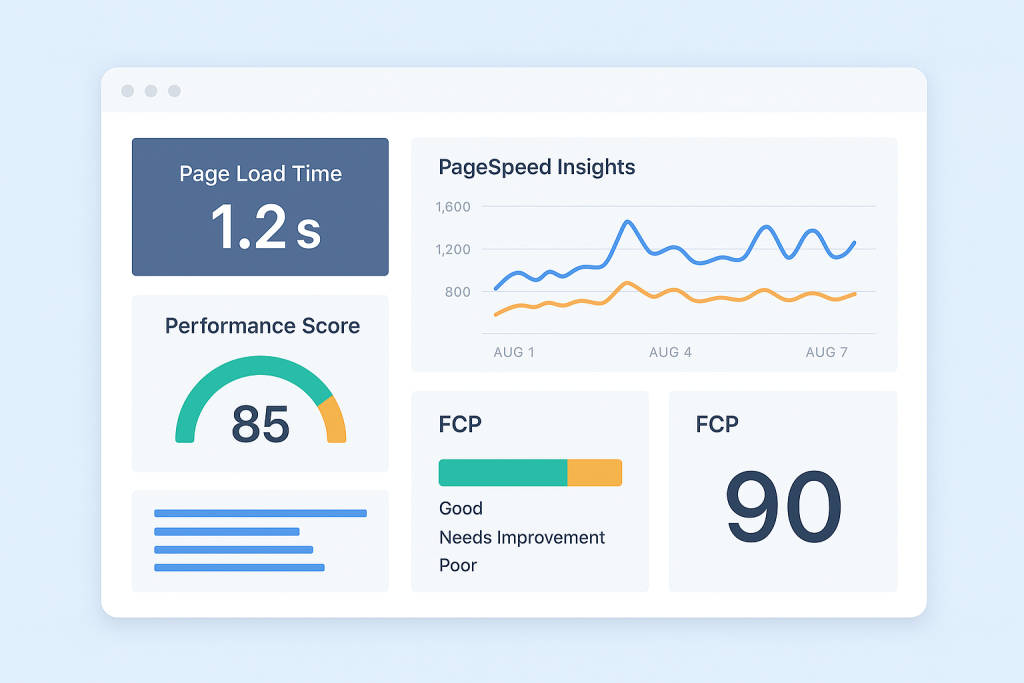
Core Web Vitals
Loading • Response • Stability
Mobile First
Built for real-world devices
Technical SEO
Performance as a wider strategy
Business Focused
Speed without needless compromises
What We Do
What Is Page Speed Optimization?
Page Speed Optimization is the process of improving the loading speed, responsiveness and overall technical performance of individual web pages. A website can become slow for many reasons, including large images, unnecessary code, poor caching, slow servers, heavy plugins and third-party scripts.
The optimization process begins by identifying what is actually slowing your pages down. Instead of making random changes or focusing only on a performance score, we look at the underlying issues and prioritize improvements that can make a meaningful difference.
Optimization may include compressing images, reducing unnecessary CSS and JavaScript, improving caching, optimizing server response times and changing how resources are delivered to visitors.
A fast website should still look good and work properly. The purpose of optimization is to improve performance without unnecessarily removing important content, features or functionality.
- Optimize performance without unnecessarily removing important functionality.
- Prioritize improvements based on your platform and business goals.
- Test changes so your key pages and features continue working correctly.
Performance is more than a number
We look beyond a single testing score and investigate the technical reasons behind slow experiences.
Identify & optimize
Large resources
0%
Reduce & defer
Unnecessary scripts
0%
Investigate bottlenecks
Server response
0%
Why It Matters
Why Website Speed Matters for SEO
Website performance can influence how people interact with your website. When pages load quickly, visitors can reach your content, services and products with less waiting. When pages are slow, visitors may abandon them before taking the action you want.
For SEO, page speed should be considered alongside content quality, search intent, technical SEO, mobile usability, internal linking and authority. Improving speed alone does not guarantee higher rankings, but it can contribute to a better overall page experience.
Fast pages can also make it easier for search visitors to explore your website. For Perth businesses, this can be particularly useful when potential customers are comparing local providers and looking for quick access to services, pricing, contact information or booking options.
A strong SEO strategy should therefore consider both what your website says and how efficiently it delivers that information.
Better User Experience
Visitors can reach services, products, contact details and important content with less waiting and friction.
SEO Support
Performance is one part of a wider page experience and technical SEO strategy. Speed alone does not guarantee rankings.
More Efficient Journeys
Faster pages can make it easier for visitors to browse, compare providers and take the next step.
Not sure what is slowing your website down?
Start with a focused performance review and find the biggest opportunities first.
Core Web Vitals Optimization
Optimize the metrics that reflect real user experience.
Core Web Vitals are user-focused metrics designed to measure important aspects of webpage experience. They focus on loading performance, responsiveness and visual stability.
Largest Contentful Paint (LCP)
Largest Contentful Paint measures how quickly the main content of a page becomes visible. A slow server, large images or resources that delay rendering can affect LCP. Improving server response, optimizing important images and prioritizing critical resources can help the main content appear sooner.
Interaction to Next Paint (INP)
Interaction to Next Paint measures how responsive a page is when a visitor interacts with it. Heavy JavaScript can make menus, buttons, forms and other interactive elements feel slow. Reducing unnecessary JavaScript work and improving script execution can help create a more responsive experience.
Cumulative Layout Shift (CLS)
Cumulative Layout Shift measures unexpected movement of content while a page loads. Visitors can become frustrated when text, images or buttons suddenly move. Defining image dimensions, managing fonts properly and controlling dynamically inserted content can help improve visual stability.
What can improve Core Web Vitals?
Critical resources
Prioritize delivery
JavaScript work
Reduce unnecessary execution
Images & fonts
Optimize and size correctly
Layout changes
Reserve space & stabilize content
Free Performance Check
Find out what is holding your website back.
Tell us a little about your website. We can use the information to understand the platform, identify likely performance areas and discuss the next steps.
- Website performance assessment
- Technical bottleneck review
- Prioritized optimization opportunities
Request Your Free Speed Audit
Complete the form and we’ll get back to you.
This demo form is ready to connect to your preferred form handler/CRM.
Website Speed Problems We Fix
Slow websites can have several performance problems at the same time. Some may be related to front-end resources, while others originate from the server or website platform.
Common issues include:
- Large and uncompressed images
- Excessive CSS and JavaScript
- Render-blocking resources
- Too many HTTP requests
- Slow server response times
- Poor browser caching
- Heavy WordPress plugins
- Inefficient themes or page builders
- Unnecessary third-party scripts
- Oversized fonts and media files
Image Optimization
Images can contribute significantly to page weight, particularly large hero banners, product photos and unoptimized media.
Compression
Smaller files
WebP / AVIF
Modern formats
Responsive images
Right size per device
Lazy loading
Load when needed
Image Optimization for Faster Websites
Images can contribute significantly to the total size of a webpage. Large photographs, banners and product images can take longer to download, especially on mobile connections.
Image optimization involves reducing file sizes while maintaining acceptable visual quality. Depending on the website, this may include compression, resizing and converting images to modern formats such as WebP or AVIF.
Responsive images can help deliver appropriately sized files to different devices. Lazy loading can also prevent non-critical images from loading before they are needed.
Good image optimization does not mean making every image look low quality. The objective is to balance visual quality with efficient loading so visitors receive the content they need without downloading unnecessarily large files.
Technical Optimization
Code and Front-End Optimization
Browsers need to process HTML, CSS and JavaScript before visitors can fully interact with a webpage. Unnecessary code can increase processing time and delay important content.
Our optimization work may include minifying CSS, JavaScript and HTML, removing unused code, deferring non-critical scripts and reducing render-blocking resources.
Third-party services can also affect performance. Analytics tools, chat widgets, advertising scripts, social integrations and other external resources may create additional requests.
We review these resources based on their purpose and performance impact. Useful functionality should not automatically be removed simply to improve a testing score.
Code & Front End
Minify HTML, CSS and JavaScript, remove unnecessary code, defer non-critical scripts and reduce render-blocking resources.
Server & Hosting
Investigate server response, hosting quality, configuration, database queries and application-level bottlenecks.
Third-Party Scripts
Review analytics, chat, advertising, social integrations and other external resources according to purpose and performance impact.
WordPress & Ecommerce
Need a deeper technical review?
Large ecommerce stores, customized WordPress sites and websites with many integrations can need optimization across several layers.
Talk to a Performance Specialist
Share your website and the areas you’re concerned about.
Mobile Page Speed Optimization
Mobile users often browse websites while using different network conditions and devices. A website that loads quickly on a powerful desktop computer may feel much slower on a smartphone.
Mobile Page Speed Optimization focuses on reducing unnecessary resources and ensuring important content becomes available quickly.
Responsive images, efficient scripts, appropriate layouts and optimized media can all contribute to a better mobile experience.
For Perth businesses, mobile performance is important because customers searching for local services may discover a business while they are away from a desktop computer. If the website is difficult to use or slow to load, that potential customer may choose another provider.
Mobile-first checks
Responsive images
✓
Efficient scripts
✓
Critical content
Prioritized
Usable interactions
Verified
Is your mobile website slower than your desktop?
Let’s identify the resources and interactions creating the biggest delays.
WordPress Optimization
WordPress Page Speed Optimization
WordPress makes it easy to build and manage websites, but performance can suffer when a website has too many plugins, a heavy theme, oversized images or poorly configured caching.
WordPress Page Speed Optimization can include reviewing plugins, optimizing media, improving caching, reducing unnecessary scripts and addressing theme or database performance issues.
Not every plugin should be removed. Some provide important features for your business. The focus should be on identifying unnecessary resources and understanding how each component affects performance.
A properly optimized WordPress website can maintain its functionality while delivering a faster and smoother experience.
Plugin Review
Identify unnecessary resources and understand how each plugin affects page performance before making changes.
Theme & Builder
Review theme and page-builder output for excess resources and opportunities to improve delivery.
Caching & Database
Improve caching and investigate database or backend performance where the website setup requires it.
Our Page Speed Optimization Process
Our approach begins with understanding your website rather than applying a standard list of changes.
Performance Assessment
We review your website’s current performance and identify areas that may be affecting loading speed, responsiveness and visual stability.
Identify Technical Bottlenecks
We analyze the causes behind delays, including large resources, inefficient code, server response problems, caching issues and third-party scripts.
Implement Speed Improvements
We prioritize practical improvements based on the website’s platform, structure and business requirements.
Test and Verify Results
After implementation, we test the affected pages again to evaluate performance and make sure important website functions continue working correctly.
Monitor Performance Over Time
Performance can change as new pages, plugins, images and tracking tools are added. Regular monitoring can help identify new issues before they become significant problems.
How Page Speed Improves Conversions
Website speed can influence the customer journey from the first visit to the final action. When pages respond quickly, visitors can browse information with less friction.
For service businesses, this can make it easier for customers to view services, find contact details, submit forms or request a booking. For ecommerce businesses, smoother product pages and checkout experiences can make browsing and purchasing more convenient.
A faster website cannot guarantee more sales on its own. However, removing unnecessary delays gives your content, SEO and conversion strategy a better environment to perform.
From click to action
Landing page
Load quickly
Service / product
Browse smoothly
Form / checkout
Respond quickly
Final action
Less friction
Page Speed Optimization for Perth Businesses
Perth businesses operate in a competitive local market where customers can compare several providers before making a decision. Your website needs to communicate clearly and provide a smooth experience from the first click.
Our Page Speed Optimization Services can support:
Local Perth business websites
Improve the experience for customers searching for local services and quick access to essential information.
Service-based businesses
Help visitors quickly reach services, pricing, contact details and booking information.
Ecommerce stores
Address performance across product pages, media, scripts, databases and checkout journeys.
WordPress websites
Review plugins, themes, images, caching and database performance according to your setup.
Lead-generation websites
Reduce unnecessary delays across landing pages, forms and important conversion paths.
Content-focused websites
Optimize resource delivery so readers can reach useful content without unnecessary waiting.
Every website has different requirements. A small local business website may need image and caching improvements, while a large ecommerce store may require more extensive work across product pages, scripts, databases and server resources.
The first step is to understand what is slowing your website down. Once the causes are clear, improvements can be prioritized according to their potential impact.
Contact BloomixSEO
Let’s talk about your website performance.
If you operate a business in Perth and want to improve your website’s performance, send us your details and a short description of what you’re experiencing.
We’ll use the information to understand the website and the areas that need attention.
Contact Us
Tell us what you need help with.
Frequently Asked Questions
Page Speed Optimization is the process of improving a webpage's loading speed, responsiveness and technical performance. It can involve optimizing images, code, caching, server performance and other resources.
There is no single loading time that guarantees a good experience for every website. Performance should be assessed using relevant metrics and real user experience, with the goal of making important content and interactions available as quickly as possible.
Website performance is one part of the broader page experience. However, search rankings depend on many factors, including content relevance, quality, authority, technical SEO and search intent. Speed should therefore be part of a wider SEO strategy.
Core Web Vitals are user-focused performance metrics that evaluate loading performance, responsiveness and visual stability. The current metrics are LCP, INP and CLS.
Yes. WordPress websites can often be improved by reviewing plugins, themes, images, caching, scripts and database performance. The exact optimization work depends on the website's setup.
The timeframe depends on the size, platform, number of pages and technical condition of the website. A simple business website may require fewer changes than a large ecommerce or heavily customized website.
Not necessarily. Many performance improvements can be implemented without changing the overall design. The first step is to identify the technical causes of slow performance and determine which changes can be made while keeping your existing website structure.
Is your website loading slower than it should?
Don’t let avoidable performance problems create unnecessary barriers for your customers. Our Page Speed Optimization Services can help identify technical issues, improve loading performance and create a smoother experience for visitors across desktop and mobile devices.
If you operate a business in Perth and want to improve your website’s performance, get in touch to discuss your website and identify the areas that need attention.